GL(s,R)

January 8, 2012

4 oz. > 100 mL

Filed under: Uncategorized — Adam Glesser @ 5:19 pm
Tags: ,

Most everyone is familiar with Santayana’s admonition that, “Those who do not learn from history are doomed to repeat it.” What is the analagous statement for mathematics? Are those who fail to learn mathematics doomed to work in food services? Doomed to playing the lottery? Doomed to credit card debt and forclosures on the house they can’t afford?

Actually, the answer is usually none of the above. In fact, most of us probably know fairly successful people whose background and skill in mathematics was as minimal as they could get away with. I know several scientists (mostly in biology) who are extremely good at what they do, but who would be terrified to sit through even our freshman level math courses. No, it does not seem that an individual’s lack of mathematical background will necessarily cost that person anything substantial. Ah, but what of a nation or a world?

Suppose a society fails to learn mathematics? I don’t mean that all individuals fail to learn, just a number so overwhelming that they permeate the government, regulatory agencies, businesses, and schools. What if a sufficient fraction of the population learns to think intuitively, rather than critically? What if enough people agree that what feels right, is right? What if the system of checks and balances fails because the counterweights just can’t keep up? What if people start to believe that these rocks are what keep the tigers away?

I am writing this as I live the answer to these questions. To which circle of hell am I referring? Circle 9er: Airport security.

I know: It is such an easy target for scrutiny, and yet without a doubt the people who work in airport security are an honest group who are doing their job and who likely sympathize with many of the travelers inconvenienced by policies they never asked for. Am I annoyed that the security officer here at Heathrow just confiscated from me the half-full 4oz. bottle of contact lens solution—which passed through American security without notice—because 4oz. is 118mL and the British limit is 100mL?* No. I am annoyed that many people in power in both (all?) countries believe that such trivial differences matter.

*Technically, they should have confiscated it in the United States since they match Britain with a 3.4oz (roughly 100mL) limit. 

How should we decide the appropriate level of security at our airports? Should experts come up with a list of reasonable ways a terrorist might attempt to take over or destroy an airplane, and then enact sufficient security measures to make those avenues of destruction prohibitively difficult? It sounds pretty good. It feels like the right solution.

Of course, if you’re one of the those anal mathematicians, then you might start questioning the definition of `reasonable ways’ and `prohibitively difficult’. At that point, it might occur to you that probability and statistics are at play here, and that these are necessary to consider before deciding upon a course of action. But those of us without a Ph.D. in pointdextery know that probability and statistics is a just a smart person’s attempt to get around the immutable law that either the plane crashes or it doesn’t; you either stop the terrorist or you don’t. Never mind the regular reports of journalists sneaking weapons or TSA agents sneaking people through security. We’d all rather be alive with a little less liberty (and contact solution) than free and dead at the bottom of the Atlantic, right?

So, I guess this is my answer: The cost of a society failing to learn mathematics is giving up some of its liberty for, well, the appearance of security? But hey, at least those badges the TSA officers wear now are keeping the tigers away.

[Update: This post was retroactively inspired (that is, I read it after I wrote this) by an article of Keith Devlin.]

December 10, 2011

Jonathan’s Advice

Filed under: Music and Videos — Adam Glesser @ 8:20 am

Final exams are coming and my four-year old son, Jonathan, has a message for my students.

Happy Finals, everybody!

September 9, 2011

Hey, I wrote a book review!

The following is a book review written this summer for the Center for Teaching Excellence at Suffolk University. The shortness of the review is not a function of the content of the book, but rather the medium (a newsletter).

Creating Significant Learning Experiences:
An Integrated Approach to Designing College Courses
L. Dee Fink
Copyright © 2003 by John Wiley & Sons, Inc.

Reviewed by Adam Glesser

Fink argues that a new paradigm is emerging in college teaching, one that encourages a focus on activities that produce significant learning experiences, valuing the quality of learning over the quantity of content coverage. In order to frame the discussion, he defines a Taxonomy of Significant Learning consisting of three categories that essentially mimic Bloom’s taxonomy of educational objectives:

  • Foundational Knowledge
  • Application
  • Integration

and three categories that go beyond Bloom:

  • Human Dimension (“students learn something important about themselves or about others” (p. 31))
  • Caring (about the subject, phenomena, ideas, their own self, others, the process of learning, etc. (p. 49))
  • Learning How to Learn

Fairly little attention is given by faculty to the latter three in the course design process, although I suspect that when pressed, most professors would espouse these as goals of their courses. In the sciences, I see some of these categories as long-term goals, built up through the entire curriculum and difficult to foster in a single course. This suggests that we need a concerted effort to consider these values collectively, not merely in isolation.

The heart of this book is the two chapters on course design. My teaching mimics that of my own teachers and so, like them, I am a member of content-aholics anonymous: the group of professors ashamed that their courses are creatively designed to include as much content as possible. Conveniently, Fink offers up a 12-step plan for designing a course. Although few of his suggestions are innovative, many of them will make you say, “That makes so much sense! Why haven’t I been doing that?”

My only complaint is the relative lack of attention given to the the grading system and its role in fostering significant learning. While the author accepts the need for “the development of a feedback and assessment system that goes beyond just grading and contributes to the learning process” (p. 142), he gives an example of a grading system that is “fair and educationally valid”, but which reduces the course, for many students, to the calculus of point grubbing.

The title sets the bar: the book is a failure if reading it is not itself a significant learning experience. Fortunately, the author succeeds in the ultimate accomplishment in pedagogical writing: he made me put the book down at times, frantic to work on designing one of my courses.

April 17, 2011

Galileo Sequences continued

Filed under: Music and Videos,Tricks of the Trade — Adam Glesser @ 3:20 pm
Tags: ,

The second video on Galileo sequences is up on YouTube. Have a look.

April 8, 2011

Channeling my inner James Tanton

Filed under: Music and Videos — Adam Glesser @ 2:27 pm
Tags: ,

In the following video, I answer a question posed to me by my friend Alla Margolina. The format is meant to pay homage to James Tanton who—when he is isn’t folding toilet paper—is writing some mighty fine books and recording engaging videos where the mantra is to simply have fun. There will be another video up soon that explores the consequences of this diagram a little more.


March 22, 2011

The title of this post was already taken

Filed under: Uncategorized — Adam Glesser @ 12:10 am

Tricks of the Trade

(with Professor Glesser)

My all-time favorite differentiation technique is logarithmic differentiation. The implementation is right there in the name: take a logarithm and then differentiate. If you are a pro with your log rules, you will understand why this would be useful.
There are two canonical types of functions where this technique is often used in standard calculus courses. The first is where you have a product and/or quotient of functions, potentially raised to a rational power. For example:
y = \sqrt[3]{\dfrac{(3x-2)^2\sqrt{2x^3+1}}{x^4(x-1)}}
If you apply the natural log to both sides—we choose base e so as to avoid unnecessary constants when differentiating (recall that when u is a function of x that \log_a(u)' = \dfrac{u'}{u \ln(a)}—then we can deconstruct the right hand side using the log rules to get:
\ln(y) = \dfrac{1}{3}\left[2\ln(3x-2) + \frac{1}{2}\ln(2x^3 + 1) - 4\ln(x) - \ln(x-1)\right].
Differentiating both sides is now a snap:
\dfrac{1}{y}\dfrac{dy}{dx} = \dfrac{1}{3}\left[\dfrac{2\cdot 3}{3x-2} + \dfrac{6x^2}{2(2x^3+1)} - \dfrac{4}{x} - \dfrac{1}{x-1}\right].
Multiplying both sides by y—which is the orignal function—gives us the derivative.
The second example is one that gives students no trouble at all, but gives teachers fits. The simplest such example is
y = x^x.
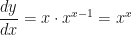
Three-quarters of the class knows that you use the power rule to get
\dfrac{dy}{dx} = x\cdot x^{x-1} = x^x.
The remaining group of students will point out that the power rule only works with a constant exponent, so instead you need to use the exponential rule which gives
\dfrac{dy}{dx} = x^x \ln(x).
Of course, the teacher is squirming right now because they know the exponential rule only works you have a constant base. In fact, neither rule is correct! However, in a way, they are both half-right. Applying the natural log to our orginal equation gives
\ln(y) = \ln(x^x) = x\ln(x).
Differentiating—using the product rule on the right—gives
\dfrac{1}{y}\dfrac{dy}{dx} = x \cdot \dfrac{1}{x} + \ln(x) = 1 + \ln(x).
Multiplying both sides by y now gives
\dfrac{dy}{dx} = y(1 + \ln(x)) = x^x + x^x\ln(x), the sum of the two incorrect answers.
SWEET
Using logarithmic differentiation on functions of the form f(x)^{g(x)}, we can get a general rule which is not particularly well-known:

SPEC (Super Power Exponential Chain) Rule

If y = f(x)^{g(x)} is differentiable, then \dfrac{dy}{dx} = g(x)\cdot f(x)^{g(x) -1} \cdot f'(x) + f(x)^{g(x)}\ln(f(x))\cdot g'(x), i.e., evaluate the derivative using the power and chain rules, then with the exponential and chain rules, and finally add the two incorrect answers together.

In short,
\begin{array}{cl} variable^{constant} & \longrightarrow \text{ Power rule (+ Chain rule)} \\ constant^{variable} & \longrightarrow \text{ Exponential rule (+ Chain rule)}\\ variable^{variable} & \longrightarrow \text{ SPEC rule: Add power rule and exponential rule answers together} \end{array}
An Example
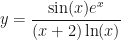
On my midterm, I asked the students to compute the derivative of y = [\sin(x)]^x. The SPEC rule makes this a piece of cake: the power rule gives x \sin(x)^{x-1}\cos(x) and the exponential rule gives \sin(x)^x\ln(\sin(x)). Adding them together gives:

\dfrac{dy}{dx} = x\sin(x)^{x-1}\cos(x) + \sin(x)^x\ln(\sin(x)).
The title
When coming up with this, I thought that the perfect title would be “Two Wrongs Make a Right.” Unfortunately, this was already taken by the authors of the paper of nearly the same name (which has to be the most obvious title for a paper—ever).  They don’t give a name to this rule, so in honor of my anime loving friends, I stick with SPEC rule for the moniker.
What about logarithmic differentiation?
One of the faculty asked me if students will avoid logarithmic differentiation now. For the first type of problem: absolutely not—the SPEC rule doesn’t really apply. For the second type: I hope so—logarithmic differentiation is useful because it simplifies calculations; why not use a trick to simplify it even more?

January 17, 2011

A multivariable calculus list

In addition to my calculus course this semester, I also get to teach a multivariable calculus course with only six students. I’ll start with the standard list for those interested in that sort of thing.

Spring 2011 Multivariable Calculus Standards List

Let me admit something, here, in between two documents—less likely to read in here—about teaching this course, now for the third time: I’m a fraud. That’s right, I’m a fake, a charlatan, an impostor. I’ve created a counterfeit course and hustle the students with a dash of hocus-pocus and a sprinkle of hoodwinking. It is only through mathematical guile that my misrepresentations, chicanery and flim-flam go unnoticed. In short, and in the passing Christmas spirit, I am a humbug. This is a physics course. It should be taught be someone proficient in physics, someone with honed intuition about the geometry of abstract mathematical notions like div, grad, curl and all that, someone who sees everything as an application of Stokes’ theorem and has strong feelings about whether it should be written Stokes’ theorem or Stokes’s theorem. About the only thing I bring to the table is that I can teach students to remember that:

\mathrm{curl}(\mathbf{F}) = \nabla \times \mathbf{F}

and

\mathrm{div}(\mathbf{F}) = \nabla \cdot \mathbf{F}

because curl and cross both start with c, while div and dot both start with d.

Here is the calendar for the course. After it, I’ll explain a little bit of what I’m trying.

Spring 2011 Multivariable Calculus Calendar

There are several big differences here from how I’ve taught this course in the past. First, I am going to try with all my might to get to Stokes’ theorem before the last week. Part of the way I plan to do this is, similar to my calculus class, to cut out most of the stuff on limits and continuity that I usually get bogged down on in the first couple of weeks—am I the only person who finds interesting the pathological examples that make Clairaut’s theorem necessary? I get to teach an extra hour a week to a subset of the class and that stuff will fit perfectly in there. For the science majors, I’m more interested in helping them figure out how to use this stuff and how to develop intuition. Second, I’m skipping Green’s theorem until the end. Yes, it changes the story I normally tell, one that progresses so nicely up the dimension chart, but the trade-off is that I get more time to show them Stokes’ theorem and more time to focus on the physical interpretation.

Speaking of interpretation, you will notice in the calendar  eleven or so ‘Group Activities’. These are stolen from an excellent guide produced by Dray and Manogue at Oregon State as part of their Bridge Project. To work within their framework, I’ve made another structural change that I’d never considered given how I think about the subject. Immediately after finishing triple integration (which, essentially, finishes the first half of the course), we start with vectors (I never start with vectors as most calculus books do) and then I want to get to line integrals and surface integrals as fast as possible. Normally, I mess around with div and curl before getting to integration of vector fields. Instead, I’m going to push out the Divergence theorem—the theorem I always cover in the last 45 minutes of the course—and use this to motivate the definition of div. Then I’ll push out Stokes’ theorem and use this to help motivate the definition of curl. This ought to give me two solid weeks to explore the physical meaning of these theorems as well as to use them to prove some of the standard cool corollaries (like Green’s theorem).

This class will also be the first of my SBG courses to incorporate a final project. If anyone has good suggestions based on experience about how best to incorporate projects into the SBGrading scheme, I would live to hear them. My current system is quite simplistic. The standards for the course are given a 90% weighting for the overall grade—did I mention that midterms and finals now are simply extended assessments whose grades are treated like an arbitrary quiz, just with a lot more standards tested?—and 10% weighting for the project.

January 12, 2011

A Calculus List

Filed under: High Effort/Low Payoff Ideas,Standard Based Grading — Adam Glesser @ 4:19 pm
Tags: ,

One of the advantages of my job is the incredible scheduling. We finished the fall semester the second week of December and my first class of the spring is next Tuesday! The downside is that this gives me way too much time to plot, scheme, doodle, dabble, think, rethink, and overthink. In the end, I usually settle on a plan that is far too ambitious, pedagogically impossible, philosophically suspect, and utterly indefensible. Thus, I bring you my plan for calculus this semester.

I read the wonderful article, Putting Differentials Back Into Calculus, which argues for using differentials in a way closer to their original creation than the way they are employed in modern textbooks.  As a huge fan of Thompson’s Calculus Made Easy, this suggestion didn’t seem half bad. Considering that only a fifth of my students are math majors and that, for the rest, using calculus outside of their physics class is unlikely, why not make things as easy as possible. I’m going to push to teach this same group next fall in calculus II, so the only teacher I can hurt is myself, right? But then I started thinking: the reason the differential approach will work so well with these students is that they will always be using differentiable functions. What reason is there to mention limits and continuity? These are technical issues that won’t help them at all in understanding calculus or how to apply it in their field of inquiry.

Oh dear, so here I am with essentially two months of material (this includes learning to differentiate any elementary function and using this to solve the standard problems). What will I do for the last month and half? I quickly remembered to add Taylor series because I love teaching that in calculus I. Then I added in the obligatory introduction to antiderivatives and integration. I even sprinkled in some partial differentiation at the end so that I could show the students the totally-awesome-implicit-differentiation-trick that would save them five minutes on the final exam. Grr…still two weeks left. These are precisely the two weeks that I usually spend on limits in the beginning. Now I remember why I always do this. It perfectly fills in the semester calendar. And then it hits me.

Any subject can be made repulsive by presenting it bristling with difficulties.
—Silvanus P. Thompson

Limits sure confuse the heck out of students. Why in the world are we leading calculus off with limits, especially to non-math majors? For the purpose of rigor?

You don’t forbid the use of a watch to every person who does not know how to make one? You don’t object to the musician playing on a violin that he has not himself constructed. You don’t teach the rules of syntax to children until they have already become fluent in the use of speech. It would be equally absurd to require rigid demonstrations to be expounded to beginners in the calculus.
—Silvanus P. Thompson

So I decide I just won’t do it.  No limits for us. We will just do some extra exploratory work. There is a great article on math in medicine we could read together. Okay, time for sleep.

But sleep does not come.

Toss.

Turn.

Toss.

Turn.

All right. All right. I’m up.

Why can’t the limits just die? Why do I feel the compulsion to put them back in? They’re like the tell-tale heart beating under my floor. What will become of my math majors if they don’t see limits? No, I can’t do that to them. What a cruel joke to play: send them to real analysis without having used limits. Back in they go. Of course, those biology majors are going to be completely turned off and once you lose them, they’re gone for good. Argh, out they go. On the other hand, if I get audited by the department, they are sure going to ask questions. With my review coming up, I can’t afford that kind of chatter. Put them back in…

…but later. Huh? Put them back in, but later. Yes, of course. Later. The course description says I need to cover limits, but it doesn’t say when! What if we introduced everything in a reasonable way and, only after the students know what is going on and why any of this is important, then showed them those funky limit do-hickies? Hmm. Interesting. And that is my explanation for the following calendar and skills list:

View this document on Scribd

January 7, 2011

At long last…

Filed under: Music and Videos — Adam Glesser @ 5:00 pm

It only took a little over a year, but I finally got my collection of complex analysis lectures online. Sadly, two of the lectures mysteriously disappeared. In any case, as far as I know, this is the only (near) complete collection of videos on introductory complex analysis available online. Thanks to all the students who wrote me over the past year requesting I put these up. I wouldn’t have done it without your prompting.

For those who don’t know what complex analysis is, let me quickly summarize the idea as doing calculus but with functions of a complex variable. Cool things happen in this world that don’t normally happen. For instance, differentiable functions are automatically infinitely differentiable. Also, there is a certain theory called residue theory which enables one to use complex integration to solve real integration problems.

Enjoy!

December 9, 2010

All Hail Ailles

Filed under: High Effort/Low Payoff Ideas — Adam Glesser @ 5:28 pm
Tags: ,

This post is a sequel of sorts to my tricks of the trade post describing how to quickly compute the standard values of sine and cosine in the first quadrant. This is a very nice little exercise, known my quite a few high school teachers, but unknown to everyone I know personally. This lesson assumes that the student is aware of the basic facts from geometry about 30-60-90 and 45-45-90 right triangles as well as the Pythagorean theorem. If they know the definition of sine and cosine, you can go a little further at the end—this is my target audience. As a good preface to this, you might start with Kate Nowak’s post on these special right triangles. We start with the following rectangle:

Give this to the students (I do it in groups) and ask them find the length of each side and the measure of each angle. Simple arithmetic will take them here:

At this point, perhaps with some nudging, they apply the Pythagorean theorem to get at least two of the missing sides of the inner triangle.

The last side might be too intimidating for your students. If so, suggest they work on the angle problem. Those right triangles on the bottom should look mighty familiar…

My students got stuck here. However, I channeled by help less personality and let them struggle a bit. A few decided to work on the missing side again, but all eventually came around to noticing the angle on the bottom had to be 90 degrees—I must have said, “I don’t know. Why do you think it is a right angle?” half a dozen times that day.

It will not surprise you how few notice that the triangle is a 45-45-90 right triangle. It will surprise you how many don’t see that they can now use the Pythagorean theorem again to get the last side.

At this point, the students should have no problem sorting out the last two angles.

At the end, you might try asking them to compute the sine or cosine of 15^{\circ} and 75^{\circ}. Normally, I teach these via the sum angle formulas, but this is a far more intuitive approach.

This rectangle was noticed by high school teacher Doug Ailles and is knows as the Ailles rectangle. Not too shabby.

Next Page »

Theme: Rubric. Blog at WordPress.com.

Follow

Get every new post delivered to your Inbox.